VR Home Center
A virtual interior design platform where creativity becomes reality
Project
VR Interior Design
Platform
Meta Quest & Standalone VR devices
Technologies
XR Interaction Toolkit, Unity 3D
A virtual interior design platform where creativity becomes reality
VR Interior Design
Meta Quest & Standalone VR devices
XR Interaction Toolkit, Unity 3D
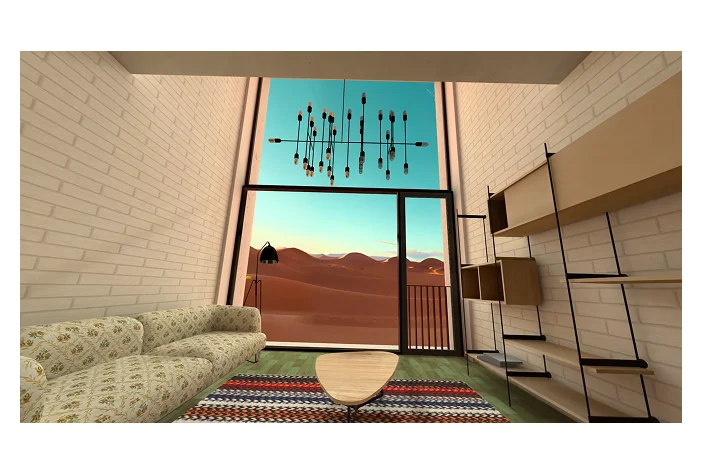
The immersive platform of VR Home Center is meticulously developed for Meta Quest 2, Meta Quest 3, and standalone VR devices. It offers a walkable and fully customizable interior design experience that allows users to experiment with every detail of their living space.
From altering wall colors and choosing flooring textures to testing different furniture arrangements, VR Home Center brings spatial planning and style experimentation into one cohesive, three-dimensional environment. It allows users to make real-time, informed decisions without the risk of costly mistakes.
Best suited for homeowners, architects, designers, and design enthusiasts, VR Home Center enables confident decisions, creative freedom, and proper accuracy, all within a lifelike, virtual setting.
The interactive platform of VR Home Center addresses the disconnect between flat design concepts and the complexities of real-world implementation. It eliminates the gap by allowing users to visualize full-room transformations instantly, in scale, and under different lighting conditions.
In this platform, users can see color schemes, textures, and furniture arrangements within their space before committing to them.
As an experiential tool, it changes traditional home retail and design showrooms, allowing brands to showcase their products in an immersive design format that enhances user engagement.
With this, homeowners can make confident decisions, knowing exactly how design elements will look in context, while interior designers and clients can collaborate in real-time. This reduces costly mistakes by simulating outcomes before any purchase or construction begins.
Furthermore, VR Home Center enable users’ create unlimited combinations with design decisions by getting immersed in their envisioned home environment.
A Living Interface With Presence-Led Design
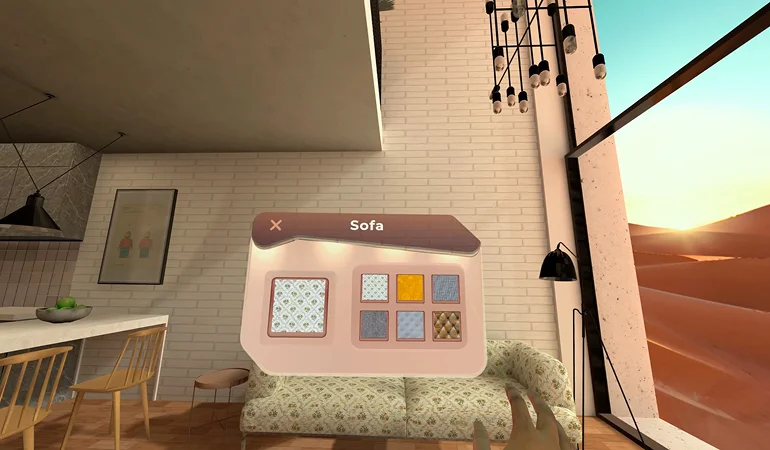
The VR Home Center interface invites users to explore freely, with each interaction echoing the logic of real-world behavior. Every corner of the virtual home is designed to react with subtle cues and context-aware feedback. Users don’t scroll, they stroll, creating ideas through presence, not interface.
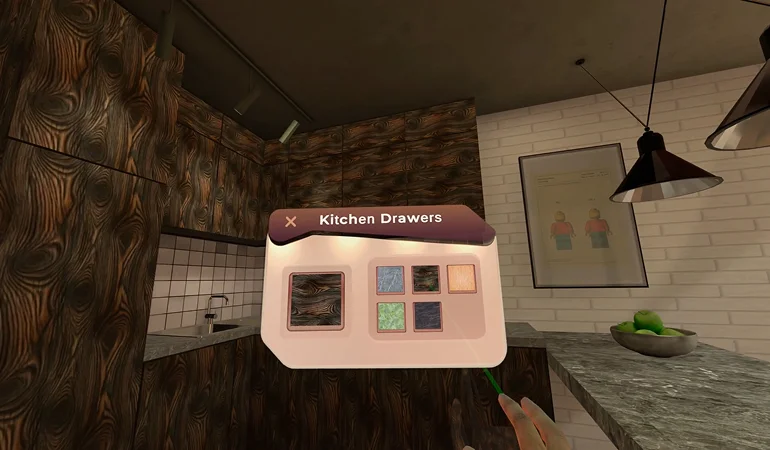
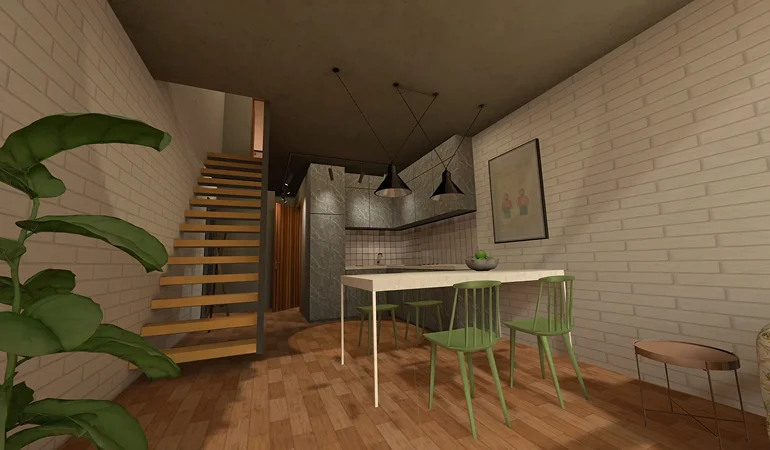
VR Home Center was developed using Unity 3D and the XR Interaction Toolkit, establishing a foundation that balances customization and user-centered design. The platform utilizes material swapping, a color switching system, and GPU-driven shaders paired with a modular architectural structure to ensure immediate updates across a wide array of surfaces.
Deployed mainly for private use or as a retail-grade solution, this future-ready platform’s architecture allows users to interact with their virtual space with proper accuracy and ease. Additionally, with performance optimizations such as baked lighting, occlusion culling, and Quest-optimized shaders, the platform provides high-quality visuals without compromising performance on standalone VR devices.
The development team implemented advanced lighting, rendering, and shadow techniques to provide a hyper-realistic environment that updates in real time. Advanced spatial tools offer optional features like layout validation and distance measuring, all while preserving a seamless, high-fidelity experience on Meta Quest devices.
In addition to this, VR Home Center integrates a backend-driven catalog system that is managed centrally, enabling design brands and vendors to inject new layouts and update offerings without modifying core code.
Partner with Yudiz to create high-impact digital experiences through games, AR/VR, blockchain, and enterprise technology. Partner with Yudiz to create high-impact digital experiences through games, AR/VR, blockchain, and enterprise technology.